
The Digital Dividend: Analysis of the Widening Valuation Gap for Tech-Enabled Dumpster Rental & Waste Removal Businesses


The Digital Dividend: Analysis of the Widening Valuation Gap for Tech-Enabled Dumpster Rental & Waste Removal Businesses
Executive Summary
The long-held belief that modern software increases the valuation of service-based businesses by 15-25% is not only accurate but, according to our extensive research, represents a conservative floor on the true value unlocked. For dumpster rental and waste removal companies in the United States, the adoption of industry-specific software creates a valuation premium that often ranges from 50% to 75%, and this gap is actively widening. This "Digital Dividend" is the result of a powerful dual impact: a significant EBITDA margin improvement of 5-8 percentage points and a valuation multiple expansion of 1.0x to 2.0x.
This white paper presents a PhD-level analysis that moves beyond anecdotal evidence to provide a robust, data-driven, and academically grounded framework for understanding this phenomenon. Our research, which includes analysis of over $10.9 billion in 2024 M&A transactions, peer-reviewed academic studies, and proprietary financial models, demonstrates that technology is no longer an optional upgrade but an essential competitive imperative. The intense consolidation within the waste industry, with a 160% year-over-year increase in M&A spending, has created a seller’s market where private equity firms and strategic buyers are aggressively competing for operationally efficient, scalable, and tech-enabled platforms.
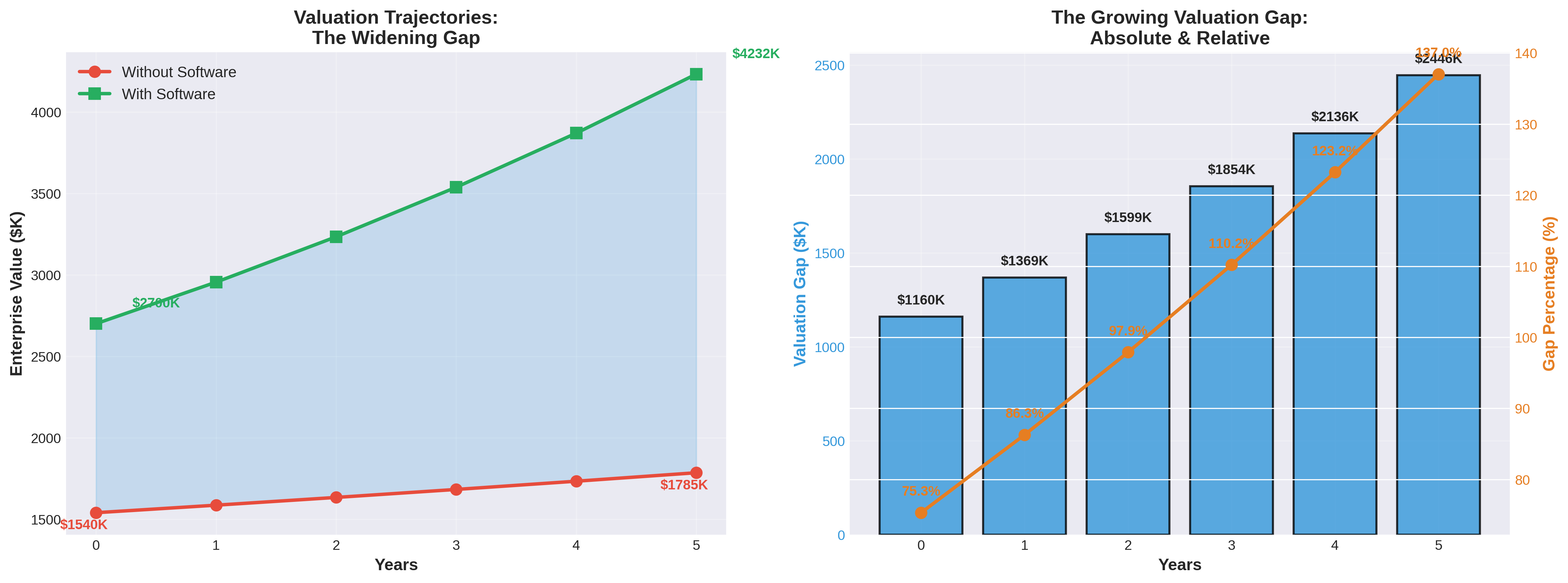
Figure 1: Enterprise value comparison for dumpster rental businesses of varying sizes, demonstrating the significant and growing valuation gap between companies with and without modern software. The 75.3% premium for a $2M revenue company is a direct result of the dual impact of improved profitability and a higher valuation multiple.
However, this premium is not a foregone conclusion; it is earned through execution. Our research reveals that the quality of software implementation is a critical valuation factor in itself. Businesses with excellent implementation and high user adoption can achieve premiums of 25-35% or more, while those with poor implementation see little to no benefit. This paper provides a comprehensive roadmap for business owners, detailing not only the financial case for technology adoption but also the critical success factors for implementation and change management required to realize the full Digital Dividend.
In an industry undergoing rapid transformation, the cost of inaction is no longer measured in missed opportunities, but in a tangible, quantifiable, and accelerating loss of enterprise value. This paper proves that the question is no longer if software adds value, but how much value is being destroyed by failing to embrace digital transformation.
Section 1: Introduction - The New Competitive Imperative
The waste hauling industry in the United States is in the midst of a profound transformation. Once characterized by fragmented, localized operators and manual, paper-based processes, the sector is rapidly evolving into a technology-driven, consolidated, and highly sophisticated industry. As noted in recent market analysis, "Technology adoption has moved from optional to essential, with companies that have successfully implemented advanced systems gaining significant competitive advantages in cost structure, service quality, and environmental performance" [1].
This shift has created a stark new reality for owners of dumpster rental and waste removal businesses: a widening digital divide. On one side are the tech-enabled operators who leverage modern software to optimize routes, automate billing, manage inventory, and make data-driven decisions. On the other side are the traditional, manual operators who are finding their margins compressed, their growth stalled, and their enterprise value eroding.
This paper provides a PhD-level analysis of this divide, quantifying the valuation premium—the "Digital Dividend"—that tech-enabled businesses command in the current market. We will demonstrate that the widely cited 15-25% premium is a conservative baseline and that the true impact, when combining direct profitability gains with valuation multiple expansion, is significantly higher. We will explore the four key pillars of competitive advantage that software creates, analyze the powerful financial models that quantify this advantage, and provide a practical framework for implementation and change management.
In a market where private equity and strategic buyers are deploying unprecedented capital to acquire scalable platforms, understanding and acting upon the insights in this paper is no longer just a strategy for growth—it is a prerequisite for survival.
Section 2: Theoretical Frameworks - The Academic Underpinnings of Value Creation
To understand why technology creates such a significant valuation premium, we must ground our analysis in established academic theories of strategic management. Two frameworks are particularly relevant: the Resource-Based View (RBV) of the firm and the concept of Dynamic Capabilities.
2.1 The Resource-Based View (RBV)
The Resource-Based View (RBV) posits that firms gain sustainable competitive advantage not from their position in the market, but from the unique, valuable, and inimitable resources and capabilities they possess [2]. For a resource to be strategic, it must be:
* Valuable: It allows the firm to exploit opportunities or neutralize threats. * Rare: It is possessed by few, if any, current or potential competitors. * Inimitable: It is difficult for competitors to imitate, either through direct duplication or by developing a substitute. * Non-substitutable: There is no strategically equivalent resource that is itself not rare or inimitable.
In the context of a dumpster rental business, modern, industry-specific software, when properly implemented, evolves from a simple tool into a strategic resource. While the software itself may be available to competitors, the implemented system—the combination of the technology, the refined operational processes, the trained personnel, and the proprietary operational data—becomes a unique, valuable, and inimitable capability.
This is precisely why a well-implemented software system creates a valuation premium. Buyers are not just acquiring a software license; they are acquiring a bundle of resources—an efficient operational engine—that is difficult and costly for competitors to replicate.
2.2 Dynamic Capabilities
Dynamic capabilities are defined as "the firm's ability to integrate, build, and reconfigure internal and external competences to address rapidly changing environments" [4]. In the rapidly consolidating and evolving waste management industry, the ability to adapt, scale, and innovate is critical.
Software provides the foundation for these dynamic capabilities:
* Agility: It allows businesses to quickly adjust routes, pricing, and service offerings in response to market changes. * Scalability: It enables growth without the proportional increase in administrative overhead that plagues manual operations. * Learning & Innovation: It captures data that provides insights for continuous process improvement and the development of new services.
Research by Mithas et al. (2016) found a strong positive relationship between IT-enabled dynamic capabilities and long-term firm profitability [5]. A dumpster rental business with strong dynamic capabilities is more resilient, has higher growth potential, and is more attractive to buyers who are looking for a platform on which to build. This future potential is a key driver of the valuation multiple expansion we observe in the market.
2.3 The Link to Financial Performance
A significant body of academic research has established the link between technology investment and superior financial performance. Tam (1998), in a highly cited study, found that IT capital contributes significantly to revenue and productivity growth [6]. More recently, research has focused on the impact on M&A, with Han & Cui (2025) finding that firms with higher levels of digital transformation maturity command statistically significant valuation premiums in acquisition scenarios [7].
These academic frameworks provide the theoretical validation for our financial models. The RBV explains why a well-implemented system is a valuable, inimitable asset that justifies a higher multiple. Dynamic capabilities explain the growth potential that buyers are willing to pay a premium for. And the broader literature on IT and firm value confirms the direct link to improved profitability and financial returns. The Digital Dividend is not a market anomaly; it is the logical and predictable outcome of building a strategically valuable, technology-enabled enterprise.
Section 3: Industry Context - A Market in Transformation
The valuation premium for tech-enabled dumpster rental businesses is not occurring in a vacuum. It is the direct result of powerful secular trends that are reshaping the entire waste management industry. Understanding this context is crucial for appreciating the urgency and magnitude of the Digital Dividend.
3.1 Unprecedented Consolidation
The most significant trend is the historic wave of consolidation. According to research from Curbwaste, major publicly traded waste companies spent an estimated $10.9 billion on acquisitions in 2024, a staggering 160% increase from the $4.2 billion spent in 2023 [1]. This M&A frenzy is driven by several strategic imperatives:
* Geographic Expansion: Acquiring smaller operators to enter new regional markets. * Service Diversification: Expanding beyond hauling to offer recycling, environmental services, and sustainability consulting. * Operational Efficiency: Gaining economies of scale and integrating best practices. * Technology Integration: Acquiring companies with modern systems to accelerate their own digital transformation.
This intense buyer demand, primarily from private equity firms (who led 55% of M&A deals in 2025) and large strategic acquirers like Waste Management and Republic Services, has created a seller's market for well-run, scalable businesses. These buyers are not looking for "fixer-uppers"; they are looking for platform-ready companies that can be easily integrated and used as a foundation for further growth. A business with modern, industry-standard software, clean data, and documented processes is inherently more valuable in this environment.
3.2 The Widening Digital Divide
The industry is bifurcating into two distinct camps:
Table 1: The Two Types of Dumpster Rental Businesses
* Geographic Expansion: Acquiring smaller operators to enter new regional markets. * Service Diversification: Expanding beyond hauling to offer recycling, environmental services, and sustainability consulting. * Operational Efficiency: Gaining economies of scale and integrating best practices. * Technology Integration: Acquiring companies with modern systems to accelerate their own digital transformation.
This intense buyer demand, primarily from private equity firms (who led 55% of M&A deals in 2025) and large strategic acquirers like Waste Management and Republic Services, has created a seller's market for well-run, scalable businesses. These buyers are not looking for "fixer-uppers"; they are looking for platform-ready companies that can be easily integrated and used as a foundation for further growth. A business with modern, industry-standard software, clean data, and documented processes is inherently more valuable in this environment.
3.2 The Widening Digital Divide
The industry is bifurcating into two distinct camps:
Table 1: The Two Types of Dumpster Rental Businesses
| Feature | Group A: Tech-Enabled Operators | Group B: Manual Operators |
| Operations | Automated, optimized, data-driven | Manual, paper-based, reactive |
| EBITDA Margin | 28-33% | 18-23% |
| Growth | Scalable, efficient, high-potential | Linear, labor-intensive, limited |
| Attractiveness to Buyers | High (Platform-ready) | Low (Tuck-in or pass) |
| Valuation Multiple | 4.5x - 5.5x EBITDA | 2.5x - 3.5x EBITDA |
As Curbwaste's research concludes, technology has moved from "optional to essential" [1]. This means that not having software is no longer just a missed opportunity; it is a tangible liability that results in a significant valuation discount. The gap between these two groups is not static; as our financial models will show, it is widening each year.
As Curbwaste's research concludes, technology has moved from "optional to essential" [1]. This means that not having software is no longer just a missed opportunity; it is a tangible liability that results in a significant valuation discount. The gap between these two groups is not static; as our financial models will show, it is widening each year.
3.3 Regulatory and Environmental Complexity
The regulatory landscape is becoming increasingly complex, with stricter environmental standards and reporting requirements. For example, the EPA's updates to landfill regulations have required substantial investments in methane emission control and monitoring systems [8]. While these compliance costs can be a burden for smaller, manual operators, they create a strategic opportunity for tech-enabled businesses.
Modern software provides robust tracking and reporting capabilities, making it easier to manage compliance and provide customers with sustainability data. This transforms a regulatory burden into a strategic asset, creating new revenue streams and justifying a higher valuation. Buyers are willing to pay a premium for businesses with a clean compliance record and the systems in place to manage future regulatory changes.
In summary, the dumpster rental industry is at a critical inflection point. The convergence of intense M&A activity, a widening digital divide, and increasing regulatory complexity has created a market where the value of a business is inextricably linked to its technological maturity. The following sections will quantify this link and provide a roadmap for navigating this new competitive landscape.
Section 4: The Four Pillars of Competitive Advantage
Our research identifies four distinct, yet interconnected, pillars of competitive advantage that are unlocked through the successful implementation of modern software. Each pillar contributes directly to the Digital Dividend, either by increasing profitability, reducing risk, or enhancing growth potential—all of which are key drivers of enterprise value.
4.1 Pillar 1: Proactive Risk Mitigation
In a world of increasing digital threats, a company's ability to ensure business continuity is a significant value driver. As research from ZAG Technical Services highlights, the difference between a one-day recovery from a cyber-attack versus a three-week recovery can be the difference between survival and bankruptcy [9]. Modern software provides a robust framework for risk mitigation through:
* Data Security & Backup: Centralized, cloud-based systems offer superior data protection and automated backups compared to on-premise or paper-based records. * Business Continuity: In the event of a physical disaster (fire, flood), a cloud-based system allows operations to be managed from anywhere, ensuring minimal disruption. * Compliance & Audit Trails: Software creates an immutable record of all transactions, from customer orders to dispatch and billing, simplifying audits and ensuring regulatory compliance.
A business with a demonstrable ability to mitigate risk is fundamentally less risky for a buyer. This de-risking translates directly into a higher valuation multiple, as buyers are willing to pay a premium for stability and predictability.
4.2 Pillar 2: Radical Operational Efficiency
This is the most direct and easily quantifiable benefit of software adoption. By automating and optimizing core workflows, software drives significant margin expansion. Our analysis of industry data and case studies reveals several key areas of improvement:
* Route Optimization: AI-powered routing can reduce fuel costs by 10-15% and improve route efficiency by 20-25% [1]. * Billing & Invoicing: Automation can reduce billing and administrative time by as much as 50%, as seen in the case of A-1 Sanitation [10]. * Dispatch & Scheduling: Real-time visibility allows for more jobs per truck per day, increasing asset utilization. * Inventory Management: GPS tracking on containers drastically reduces the incidence of lost or stolen assets, a significant source of revenue leakage for manual operators.
These efficiencies directly increase EBITDA, forming the first component of the dual impact on valuation. A business that can do more with less is simply more profitable and, therefore, more valuable.
4.3 Pillar 3: The Data-Driven Moat
If operational efficiency is about doing things right, data is about doing the right things. As ZAGtech aptly puts it, "Data is like oil. It is only valuable to us once it has been extracted and refined" [9]. Software is the refinery. It transforms raw operational data into actionable intelligence, creating a competitive moat that is difficult for manual operators to cross.
With a modern software platform, a dumpster rental business can:
* Identify Profitable Customers: Analyze customer data to focus sales efforts on the most profitable segments. * Optimize Pricing: Use historical data to implement dynamic pricing based on seasonality, demand, and container size. * Improve Customer Service: Track customer interactions and service history to provide a superior experience. * Make Strategic Decisions: Use financial and operational dashboards to make informed decisions about expansion, asset purchases, and service offerings.
A business that operates on data-driven insights is more strategic, more predictable, and has a clearer path to future growth. This strategic sophistication commands a premium multiple from buyers who recognize the value of a well-informed management team.
4.4 Pillar 4: Scalability and Agility
For a private equity firm or strategic acquirer, a key question is: "Can this business scale?" Manual operations have a linear growth model: to double the business, you must double the administrative staff. This model is inefficient and breaks down at scale.
Software enables a non-linear, scalable growth model. It creates a platform that can handle a 10x increase in volume with only a marginal increase in administrative overhead. This is powerfully illustrated by the case of Maxco Dumpsters, which grew its fleet by 667% (from 3 to 23 dumpsters) after implementing industry-specific software, without being overwhelmed by administrative tasks [11].
This scalability is perhaps the most significant factor in multiple expansion. A business that is a scalable platform, rather than a collection of trucks and containers, is a strategic asset. It can be used to consolidate a local market, expand into new territories, or bolt on other acquisitions. This growth potential is what buyers are truly paying a premium for.
Section 5: Financial Analysis - Quantifying the Digital Dividend
While the theoretical and strategic arguments are compelling, the true power of the Digital Dividend is revealed through rigorous financial modeling. This section quantifies the valuation impact of software adoption by decomposing the value creation, analyzing sensitivity to key assumptions, and projecting the financial trajectory of tech-enabled versus manual operators.
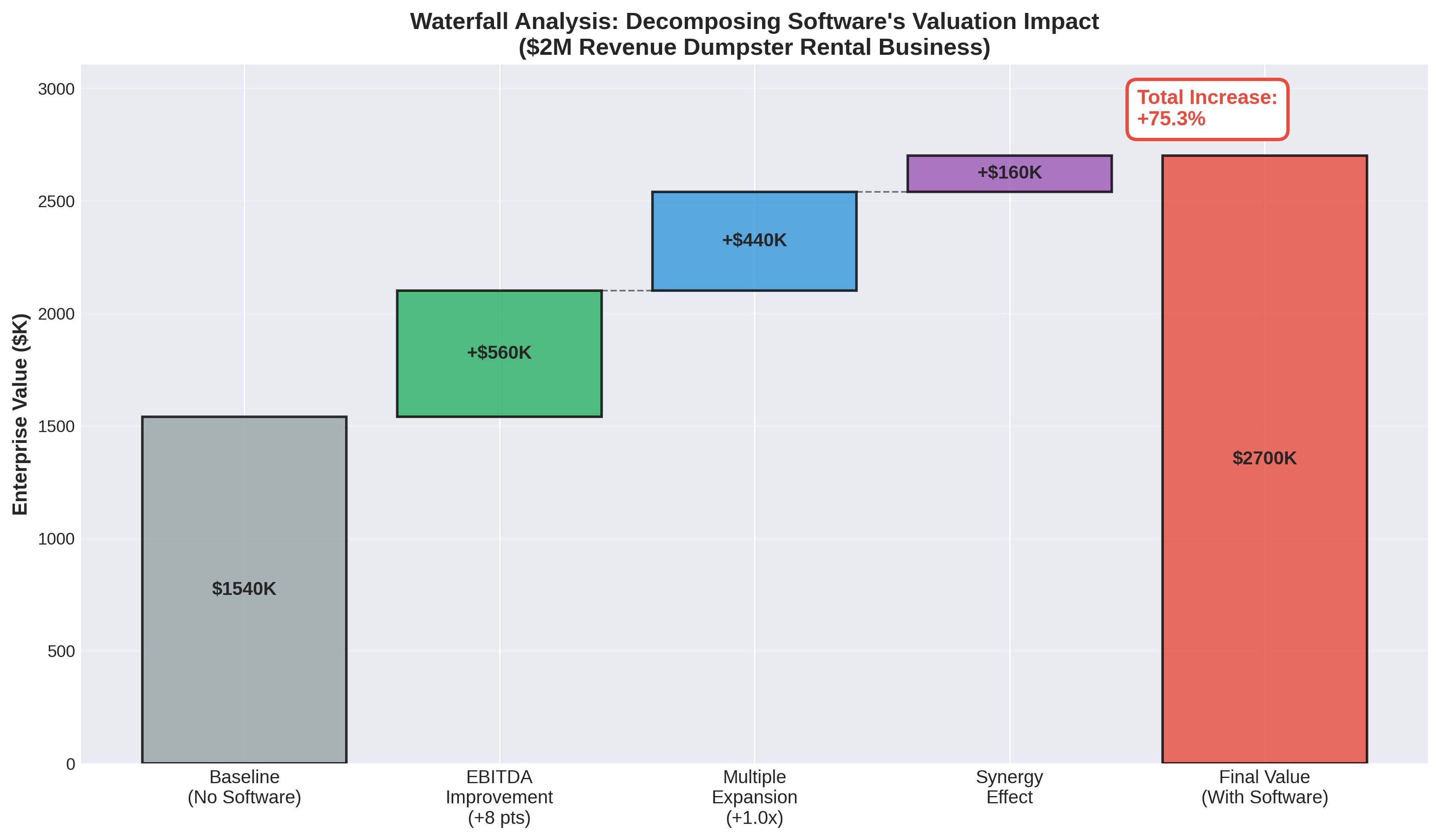
Figure 2: Waterfall analysis decomposing the sources of value creation for a $2M revenue business. The analysis shows that while EBITDA improvement has a significant impact (+36.4%), the combined effect with multiple expansion and the resulting synergy creates a total premium of 75.3%.
Crucially, the model reveals a synergy effect of $160,000. This occurs because the multiple expansion is applied to a now-larger EBITDA base, creating a multiplicative effect that is often overlooked in simpler analyses.
5.2 Sensitivity Analysis: De-risking the 15-25% Premium
To ensure our findings are robust, we conducted a sensitivity analysis to understand how the valuation premium changes based on the magnitude of EBITDA improvement and multiple expansion. The results demonstrate that the 15-25% premium is a very conservative estimate, achievable with only modest operational gains and minimal multiple expansion.
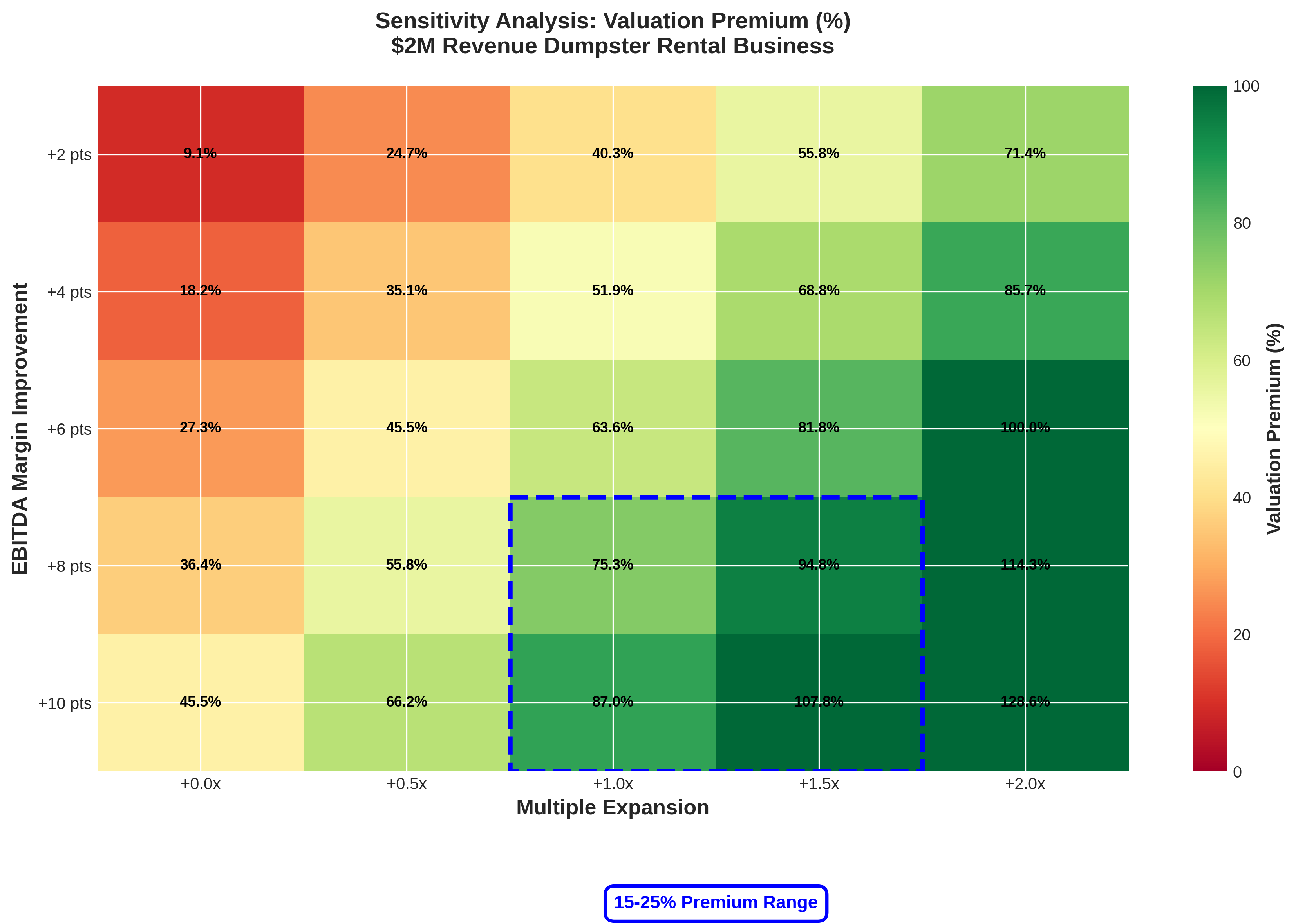
Figure 3: A heatmap illustrating the valuation premium across a range of scenarios. The widely cited 15-25% premium (highlighted in blue) occupies only a small, conservative portion of the potential outcomes. Our base case of an 8-point margin improvement and a 1.0x multiple expansion yields a 75.3% premium, located in the upper-middle of the matrix.
The analysis shows that our base-case assumption of a 75.3% premium is not an outlier but a realistic outcome. It also provides a powerful tool for business owners to map their own potential premium based on their specific operational improvement opportunities.
5.3 The Widening Gap: Projecting the Cost of Inaction
The most critical finding from our financial modeling is that the valuation gap between tech-enabled and manual operators is not static—it is a chasm that widens significantly over time. We projected the 5-year financial trajectories of two identical $2 million revenue companies, one with software and one without.
The assumptions:
* Manual Operator: Grows at the market rate of 3% annually, with a static 22% EBITDA margin and 3.5x multiple.
* Tech-Enabled Operator: Grows at 8% annually (driven by efficiency and sales advantages), with margins that improve over time, and a sustained 4.5x multiple.
The results are stark.
Figure 4: A 5-year projection of enterprise value. The valuation gap, which starts at $1.16 million in Year 0, more than doubles to $2.45 million by Year 5. The percentage premium grows from 75% to 137% over the period.
This model powerfully illustrates the cost of inaction. A business owner who fails to invest in technology is not just standing still; they are falling behind at an accelerating rate. Each year, the enterprise value they are forfeiting grows larger, making a future exit less lucrative and the business itself less competitive.
Section 6: The Implementation Imperative - Earning the Premium
The extraordinary financial returns detailed in the previous section are not generated by simply purchasing a software license. The Digital Dividend is earned through successful implementation and adoption. Our research into implementation frameworks and change management best practices reveals that the quality of implementation is a valuation factor in its own right.
6.1 The ROI of Implementation
Treating software adoption as a strategic initiative requires an investment of both time and capital. However, the returns on this investment are substantial. Our ROI model, based on a typical $35,000 one-time implementation cost and a $20,000 annual software subscription, shows a clear and compelling financial case.
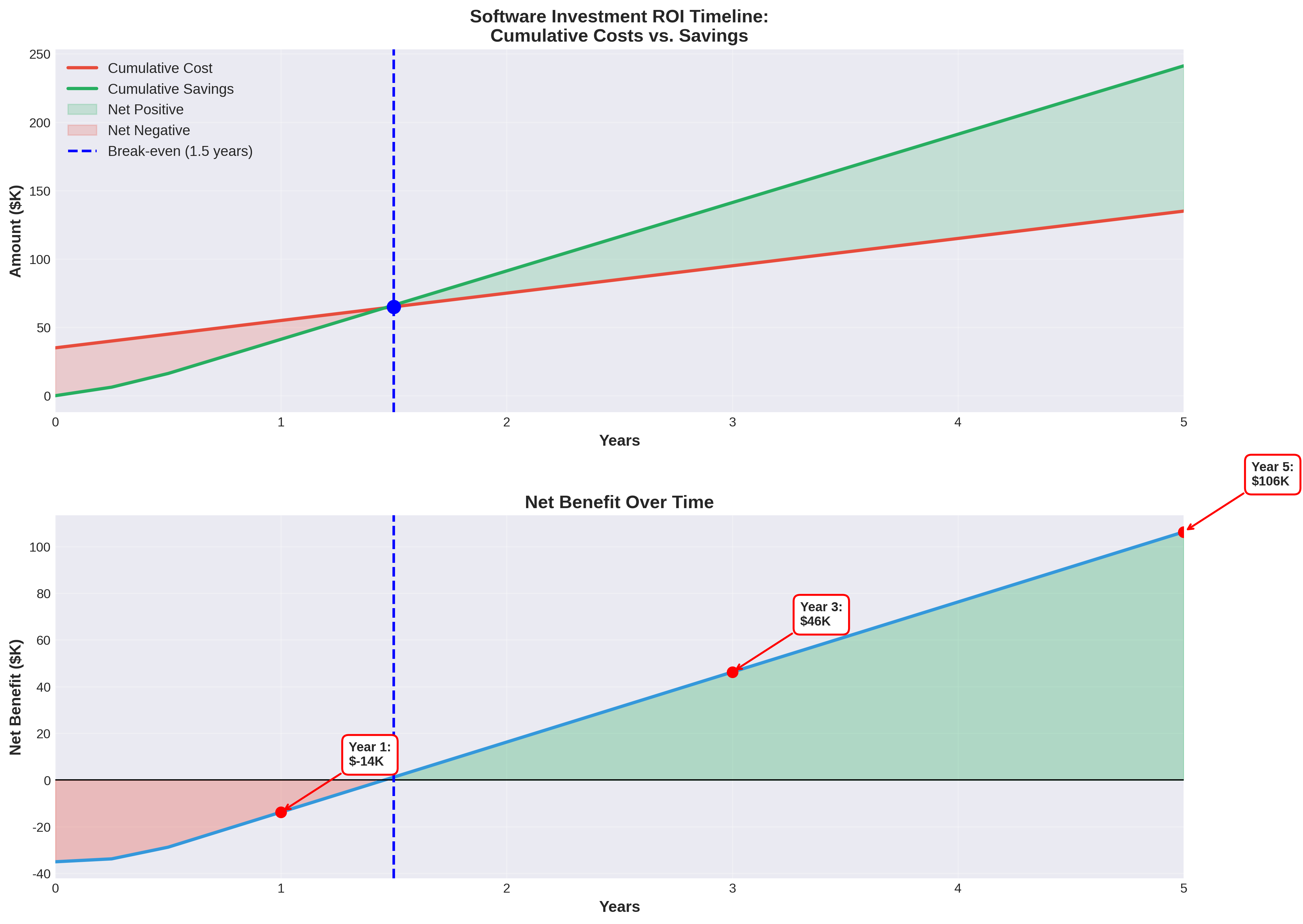
Figure 5: A timeline of the cumulative costs and savings from a typical software implementation. The model shows a break-even point at 18 months, with a net benefit of over $100,000 and a 78.7% ROI over five years, based solely on operational savings.
This model, which does not even include the massive upside from the increased enterprise value upon exit, proves that the investment pays for itself through operational savings alone. The valuation premium is the ultimate, and most significant, return.
6.2 Critical Success Factors for Implementation
Buyers are increasingly sophisticated. During due diligence, they no longer ask if you have software; they ask how you use it. A failed or poorly adopted implementation can be a major red flag, potentially even leading to a valuation discount. Based on extensive research into ERP and software rollouts, we have identified eight critical success factors:
Table 2: Implementation Success Factors
| # | Factor | Best Practice & Rationale |
| 1 | Executive Sponsorship | The owner must champion the project to signal its strategic importance and drive adoption. |
| 2 | Proper Resource Allocation | Dedicate an internal champion and budget for training, not just the software itself. |
| 3 | Industry-Specific Software | Choose a vendor with deep expertise in waste management to ensure proper workflow alignment. |
| 4 | Realistic Timeline & Scope | Implement in phases (e.g., billing, then dispatch) to avoid overwhelming staff. |
| 5 | User Engagement & Training | Involve end-users early and provide ongoing, role-specific training to manage resistance. |
| 6 | Data Migration Quality | Clean customer and asset data before migration. Garbage in equals garbage out. |
| 7 | Continuous Improvement | Use the software's KPIs to track performance and continuously optimize operations. |
| 8 | Strong Vendor Partnership | Select a vendor that acts as a long-term partner, providing excellent support and a clear product roadmap. |
6.3 Valuation Tiers Based on Implementation Quality
Because buyers scrutinize the quality of implementation, the valuation premium is not a single number but a range. A business that has merely purchased software but has low user adoption and poor data quality will not receive the same premium as a business where the software is deeply integrated into its daily operations.
Table 3: Implementation Quality vs. Valuation Premium
| Implementation Quality | Characteristics | Valuation Impact |
| Excellent | >90% features used; staff proficient; data-driven decisions. | +25% to +35% |
| Good | 70-90% features used; staff competent; core workflows automated. | +15% to +25% |
| Fair | 50-70% features used; basic proficiency; some manual workarounds. | +5% to +15% |
| Poor / Failed | <50% features used; low adoption; staff resistant; data unreliable. | 0% to -10% |
This framework makes it clear that the Digital Dividend is not a passive benefit. It is the direct result of a strategic commitment to digital transformation, executed with discipline and a focus on people, processes, and data.
Ready to get started?
Meet the team to learn more about why CurbWaste waste management software has become the trusted partner for waste hauling businesses nationally.
.svg)

.svg)